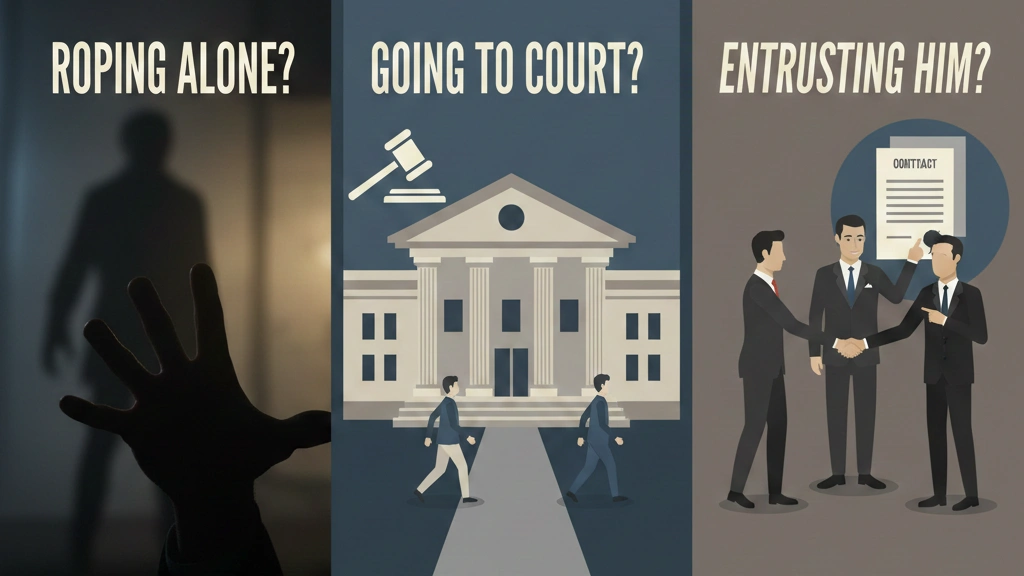

Accept the trust of others, and be loyal to others. Efficient, confidential and secure. It's a matter of loyalty. Efficient, confidential and secure.
Clearing the Fog to See the Truth: A Panoramic Guide to the Current Situation of China's Private Detective Industry and Guangdong Practice
2026-01-13

The value of truth and the boundary of law
In China, the term "private detective" carries complex contradictions - it is legally an "invisible person", but in real life it is the last sustenance of countless people. Every year, tens of thousands of parties seek the help of private investigative agencies in the desperation of marital crises, business disputes, debt recovery. They do not want to snoop on privacy, but in an era where judicial resources are limited and information asymmetry has become the norm, they are eager to protect themselves through the truth.
GAOGE's mission is to be the "guardian of the truth" in this gap between law and reality. We do not indifferently say that "detectives are not legal", but with profound legal rationality and humanistic warmth, we tell everyone in need that the truth is not harm, but a kind of protection. The investigation is not an infringement, but a manifestation of the parties' exercise of civil rights in accordance with the law.
Chinese Private Detective: The Transformation from Forbidden Zones to Gray Zones
The "prohibition" of the law and the "demand" of reality
In 1993, the Ministry of Public Security issued a far-reaching ban - the "Notice on Prohibiting the Establishment of Private Investigation Agencies". The notice clearly points out that it is strictly forbidden for any unit or individual to open various forms of "civil affairs investigation institutes" and "security affairs investigation offices" and other detective private institutions. The former State Administration for Industry and Commerce also subsequently confirmed that it is strictly forbidden to privately open a detective business, and the market supervision department has maintained this position to this day.
The ban has been in place for more than three decades, but it has not stopped the private investigation industry from booming in the market. Why? Because there is a huge "rigid demand gap" in reality. In marital disputes, the true identity, property or bad behavior concealed by one party can often only be discovered through professional investigation. In business cooperation, if the authenticity of the partner's qualifications, historical disputes, and financial health status cannot be obtained, there is a lack of rational basis for investment decisions. In debt recovery, the property concealment behind "difficult enforcement" requires professional clue collection to crack.
Because of this practical demand, the industry has gradually evolved from a "complete ban" to a "legal gray area". Many institutions are legally registered under the names of "civil investigation and consultation", "market research", "information consultation", etc., and conduct business under the permission of the industrial and commercial departments. On the surface, they keep their distance from the legal exclusion zone, but in fact they provide professional services in the fields of civil evidence collection and background checks.
Clarification of identity: the boundary between "private detective" and "civil investigation consulting firm"
The core of why the legal ban has not completely eliminated the industry lies in a seemingly subtle but actually far-reaching distinction - what is a prohibited "detective agency" and what is a permitted "civil investigation consultation"?
The prohibited "private detective agency" refers to an institution with detectives as the main business entity and secret investigation and investigation as its main business. Such institutions often have clear detective identities such as "private detectives" and "detective agencies", which directly violates the prohibited areas of the law.
The permitted "civil investigation consulting companies" are based on legal industrial and commercial qualifications, usually "business investigation", "market information consulting", "legal consultants" and other categories, to provide clients with civil services such as background investigation, information verification, and evidence and clue collection. The two are significantly different in name, operation process and legal liability. GAOGE adopts the latter model - conducting business within the framework of civil forensics through fully legal industrial and commercial qualifications.
This distinction seems to be "technical", but in fact reflects the rational adaptation of Chinese law to the needs of reality. The state not only adheres to the legal bottom line that does not allow "detectives" to exist as a profession, but also opens a door to compliance for real social needs by recognizing the legality of "civil investigation and consultation".
Guangdong: Pioneer experiment in civil investigation compliance
Why Guangdong?
Among all provinces in China, the civil investigation and consulting industry in Guangdong is the most developed, standardized, and professional. This is not accidental, but determined by deep regional characteristics.
Shenzhen and Guangzhou, as the forefront of reform and opening up, have long attracted businessmen and immigrants from all over the country. The high floating population has given rise to a large number of cross-border marriages, cross-border trade, and complex investment and financing activities. In these complex transactions and relationships, information asymmetry becomes commonplace. a business partner from another place may conceal a record of dishonesty in the local area; A cross-city long-distance marriage may contain a previous marriage or economic situation that the other party conceals. This reality has created a strong demand for professional investigative services.
At the same time, the legal community in Guangdong has also realized this problem earlier. In order to solve the stubborn problem of "difficulty in investigating and collecting evidence" for lawyers in civil litigation, the Guangdong Provincial High People's Court and the Department of Justice jointly issued the "Provisions on the Implementation of Lawyers' Investigation Orders in Civil Litigation (Trial)" on December 28, 2018. This provision is the most systematic and standardized exploration of the "lawyer investigation order" system nationwide. It clearly stipulates that when a civil litigant and his lawyer cannot collect relevant evidence in a litigation case on their own due to objective reasons, upon the application of the lawyer and the review and approval of the people's court, the lawyer shall investigate and collect relevant evidence from the unit or individual under investigation.
In November 2024, the Shenzhen Intermediate People's Court further improved its work procedures, making the operation of lawyer investigation orders more detailed and easier to enforce. This series of institutional innovations has made the civil investigation industry in Guangdong gradually move towards "sunshine" and "institutionalization". It is in such a regional legal environment that R0FPR0U a compliant, transparent and efficient civil investigation system has been gradually established through close cooperation with lawyers and in-depth cooperation with court procedures.
The "Pitfall Avoidance Guide" for Compliance Detective Agencies
How to identify a reliable survey agency?
The market is full of survey companies with various names. Some institutions blatantly violate the law in the name of "detectives", while others commit fraud under the guise of "investigation and consultation". The parties need to learn to identify. What characteristics should a truly compliant and reliable investigation agency have?
The legality and transparency of industrial and commercial qualifications
First, check the business license of the institution. The business scope of a compliant civil investigation consulting institution should include words such as "business investigation", "market information consultation", and "information consultation", and should not include prohibited words such as "detective" and "private detective". The industrial and commercial qualifications should be available on the official website of the local market supervision department, and there should be annual inspection records over the years. If an institution's industrial and commercial information is false, expired or unverifiable, it is the first red flag.
Statement of legality of evidence collection methods
A true compliance agency will clearly tell customers what they cannot do. For example, do not install locators, do not secretly take pictures of the house, do not record phone calls (violating the provisions of the Civil Procedure Law on legal evidence collection), and do not impersonate others to conduct deceptive investigations. A good faith investigative agency should clearly list in the entrustment agreement the legal methods of evidence collection that it will use, as well as the illegal means that it clearly refuses. If an institution promises to "investigate everything and dare to use any means", this itself violates the bottom line of the law.
Integrity of the confidentiality system
A reliable organization must have strict data protection and customer information firewalls. GAOGE and other professional organizations have confidentiality agreements with all employees to manage client information in segments – even internal employees do not have complete information about a case. Institutions should be able to provide a formal Non-Disclosure Agreement or Non-Disclosure Agreement (NDA) that clearly states the legal consequences of breaching confidentiality obligations. In addition, all original materials after the investigation is completed shall be destroyed in accordance with the law, leaving no future troubles.
Professional background and legal compliance
The investigative agency shall have personnel with legal backgrounds. Many members of the core investigation team of GAOGE have legal professional qualifications and can understand the provisions of the Civil Code on the right to privacy, the requirements of the Civil Procedure Law on the validity of evidence, and the bottom line of Article 253-1 of the Criminal Code on the crime of "infringing on citizens' personal information". This ensures that every investigative activity is carried out within the legal framework, and that each investigative report can form a complete "chain of evidence logic" that can be directly used for litigation support or to provide clues to lawyers.
Where is the "red line" between legal forensics and privacy infringement?
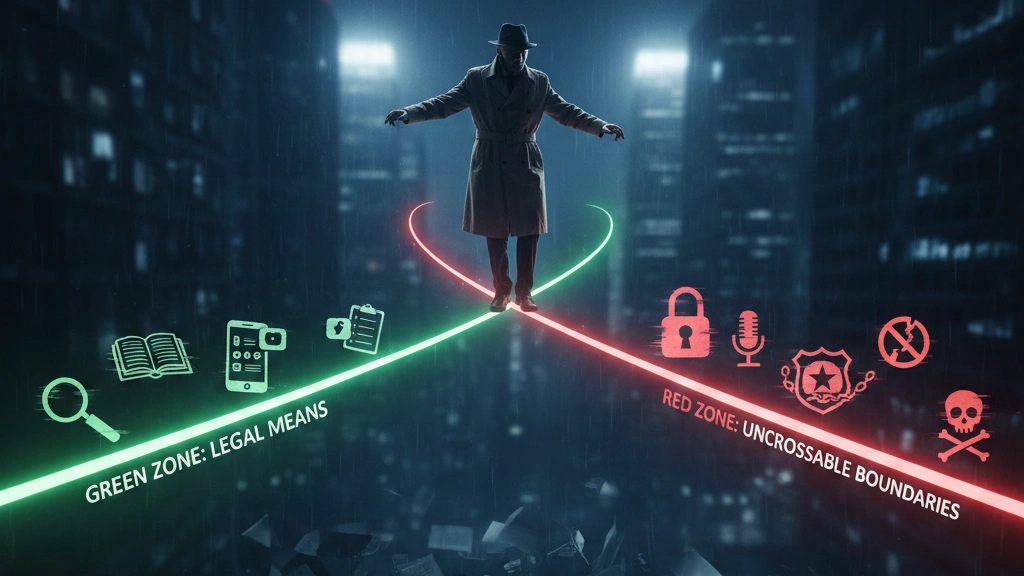
The forbidden area and legal space of the law
Understanding legal boundaries is crucial for both investigative agencies and clients. When many people commission investigations, they will make some seemingly "reasonable" demands, but in fact they violate the law. Similarly, many institutions may cross legal red lines in order to please customers and gain business. A rational and legally rational investigation process must clearly distinguish between "forbidden areas" and "legal spaces".
⚖️ Legal forbidden area - resolutely untouchable
According to Article 253-1 of the Criminal Law of the People's Republic of China,"Illegally obtaining, selling, or providing citizens' personal information"It is a criminal act. What is "illegal acquisition"? Including hacking into the systems of banks, mobile operators and other institutions; by bribing or coercing civil servants or corporate employees to disclose personal information; obtain information by illegally invading other people's communication devices or residences. These acts not only constitute an infringement of the right to privacy civilly, but also face a criminal penalty of up to three years in prison.
⚖️ Core protection of the right to privacy (Article 1033 of the Civil Code)
No organization or individual shall infringe on the privacy rights of others in the following ways: (1) entering, filming, or peeking into the private space of others; (2) Filming, recording, and disclosing other people's private activities; (3) Filming, peeping, recording, and disclosing the intimate parts of other people's bodies; (4) Processing of other people's private information; (5) Disturbing the private life of others by means of phone calls, text messages, instant messengers, emails, leaflets, etc. This means that no agency can conduct undercover tracking, secret recording, forced entry into private spaces, etc. for the purpose of collecting evidence.
So, where is the legitimate investigative space?
Three legal channels for legal evidence collection
- query and cross-validation of public information: Inquire about enterprise information through the industrial and commercial department, inquire about real estate information through real estate registration, inquire about litigation and dishonesty records through court announcements, inquire about vehicle registration through the vehicle management department, and inquire about the authenticity of academic qualifications through the education department - these information are public resources, and legal inquiries do not constitute infringement. GAOGE is based on systematic cross-verification of this public information, finding logical contradictions, and discovering the truth.
- Background verification based on legal entrustment: The client expressly authorizes the investigator to conduct the investigation, which is based on the legal embodiment of the "right to know". For example, background checks on the other party before marriage, qualification verification before business partners, and background checks on candidates before employment - these are common and reasonable exercises of private rights in society. As long as it does not use methods that infringe on privacy (such as home entry filming, illegal recording), but is carried out through legal information synthesis, neighborhood visits (non-harassing), social circle observation, etc., it is legal.
- Judicial formality of a lawyer's investigation order: This is an important channel for innovation in Guangdong. When a lawyer represents a civil lawsuit, if he is unable to collect evidence on his own, he can apply to the court for a "lawyer investigation order". After the court approves it, the lawyer can investigate and collect evidence from specific departments (such as banks, tax agencies, public security departments, etc.). This is a formal power granted by law, with judicial endorsement, and its legitimacy is the highest.
GAOGE
Commissioning and compliance audits
↓
The client entrusts → legal team to evaluate feasibility → confirm legitimate channels → sign a confidentiality agreement
↓
Legal evidence collection stage
↓
Public information inquiry → cross-verification → forming initial clues → contactless observation
↓
Chain of evidence construction
↓
Information legality review → logical reasoning closed-loop → formation of investigation reports → can be used by lawyers to apply for investigation orders
↓
Information protection and destruction
↓
Physical isolation of customer information → Destroy original materials after the case is completed → Retain the report for filing
This process ensures that every link has a legal basis, every information has a protection mechanism, and every result can withstand judicial cross-examination.
The three-sex test and evidence validity of civil evidence collection
Even if the investigation process is completely legal, the information collected may be excluded in court if it does not meet the requirements of the "three elements of evidence". Both the Civil Procedure Law and the judicial interpretation of the Supreme People's Court clearly stipulate that evidence must be authentic, legal, and relevant at the same time.
AuthenticityIt refers to the fact that the objective facts reflected in the evidence are accurate and have not been tampered with. A false investigation report, even if it is perfectly formed, will be excluded by the court due to a defect in authenticity.LegalityIt means that the method, source, and collection procedures of evidence are in accordance with the law. An evidence obtained through illegal means, even if the content is true, will be excluded due to illegal acquisition.RelevanceIt refers to the logical relationship between the evidence and the facts to be proved, which can be used to prove or refute a fact.
GAOGE provides the investigation report, and its source, collection method, and authenticity verification method will be marked before each conclusion. The purpose of this is to provide sufficient room for interpretation in court. When the lawyer submits this report in court, even if the other party cross-examines, the lawyer can clearly point out that this information comes from the public inquiry of the industrial and commercial department and has official authority; That message came from the real estate registration system, which was a government announcement; The third piece of information is logical reasoning based on multiple public information, and the reasoning process is clear and traceable. Such a report can usually pass the judge's "three natures of evidence" review.
Frequently Asked Questions
Q1: Can evidence investigated by private investigators be used directly in court?
▼
Generally, it is not possible to directly present evidence in court. The evidence obtained by private investigation agencies is considered "verbal evidence" or "physical evidence", and its effectiveness depends on the legality of the acquisition. The usual practice is that the investigation agency submits the collected clues and preliminary evidence to the lawyer, and based on these clues, the lawyer applies to the court for a "lawyer investigation order", and the lawyer investigates and collects evidence from the relevant departments in the name of formal justice, so that the evidence obtained can have the strongest legal effect. Alternatively, the report of the investigative agency is used as a reference material for the "appraisal opinion", and the appraiser appears in court for cross-examination. In short, compliant investigative agencies provide "chain of evidence clues" rather than "direct evidence".
Q2: Does China currently allow private detective agencies to be opened?
▼
The clear answer is: it is not allowed to register and operate under the name of "detective agency". The 1993 ban of the Ministry of Public Security is still in effect, prohibiting any unit or individual from opening various forms of "civil affairs investigation institutes" and "security affairs investigation institutes" and other detective institutions. However, civil investigation business is allowed in accordance with the law in the name of "business investigation consultation" and "market information consultation". This seems to be a play on words, but in fact it reflects a rational attitude of the law: both conservatively prohibiting the existence of the profession of "detective" and pragmatically acknowledging the legitimate need for civil investigation consultation.
Q3: How to ensure that personal privacy is not leaked in reverse when commissioning an investigation in Guangdong?
▼
This is the key reason for choosing a professional and compliance organization. GAOGE has signed a legally binding "confidentiality agreement" with all employees and partners, and will face civil compensation or even criminal penalties for violating confidentiality obligations. In addition, customer information is physically isolated through a "segmented operation" mechanism – for example, the data collection department does not know the identity of the client, the analysis department does not touch the raw data, and only executives can see the complete project information. This way, even if an employee wants to leak information, they won't be able to access the full sensitive content. Finally, after the case is completed, all original investigation materials are destroyed in accordance with regulations, and only the final report is retained for filing. This series of mechanisms ensures that the identity and privacy of the principal are protected at the highest level.
Q4: What are the legal consequences for illegally obtaining personal information?
▼
According to Article 253-1 of the Criminal Law, if the circumstances are serious, the illegal acquisition, sale or provision of citizens' personal information shall be punished by fixed-term imprisonment of not more than three years or short-term detention, and a fine or both; if the circumstances are particularly serious, they shall be sentenced to fixed-term imprisonment of not less than three years but not more than seven years. At the same time, Article 1033 of the Civil Code also stipulates that if the privacy rights of others are infringed, the infringed person has the right to demand that the infringer stop the infringement, apologize, and compensate for mental damages if it causes mental damage. This means that institutions and clients who use illegal means to conduct investigations may face double penalties - not only by civil courts, but also by criminal courts.
Q5: How do I apply for a "lawyer investigation order"?
▼
In Guangdong, the process is relatively standardized. First, the client must have an ongoing civil litigation case or a clear plan to file a civil lawsuit. Secondly, the lawyer shall apply to the presiding judge for an investigation order, explaining the necessity and specific object of the investigation. After the court's review, if approved, it will issue a "lawyer's investigation order", stipulating the scope, object, and validity period of the investigation. Then, the lawyer investigates and collects evidence from relevant departments (such as banking, taxation, housing management, etc.) with an investigation order. The department under investigation shall cooperate in accordance with law and shall not refuse. This is the most formal and guaranteed way to collect civil evidence. GAOGEAs an investigative agency, we can cooperate with lawyers to complete the process and support lawyers in their search warrant applications through our professional leads.
Let the evidence have temperature and the truth have power
The end point of the investigation should not be destruction, but protection. Protect innocent people from being deceived, protect enterprises from being infringed, and protect the parties to have sufficient information support when making major decisions in life.
China's private detective industry is undergoing a transformation from a "legal exclusion zone" to a "standardized exploration". As a pioneer in this transformation, Guangdong has gradually turned the former "gray area" into a "compliance business under the sun" through the innovation of the lawyer investigation order system, the legalization of civil investigation and consultation, and the self-discipline construction of professional institutions.
The value of GAOGE lies in standing firmly at the intersection of legal rationality and humanistic temperature in this transformation. We do not hide the legal difficulties of the industry and do not give up responding to the real needs of society. We tell every client that the truth can be obtained in a legal, professional and warm way. We also tell each adversary that our investigation is not about infringement, but about protecting; Not for harm, but for protection.
Pushing through the fog to see the truth is not to hurt, but to protect.
Within the framework of the law, we use professionalism and temperature to protect everyone who seeks the truth.
GAOGESurvey · Guardian of truth