
Accept the trust of others, and be loyal to others. Efficient, confidential and secure. It's a matter of loyalty. Efficient, confidential and secure.
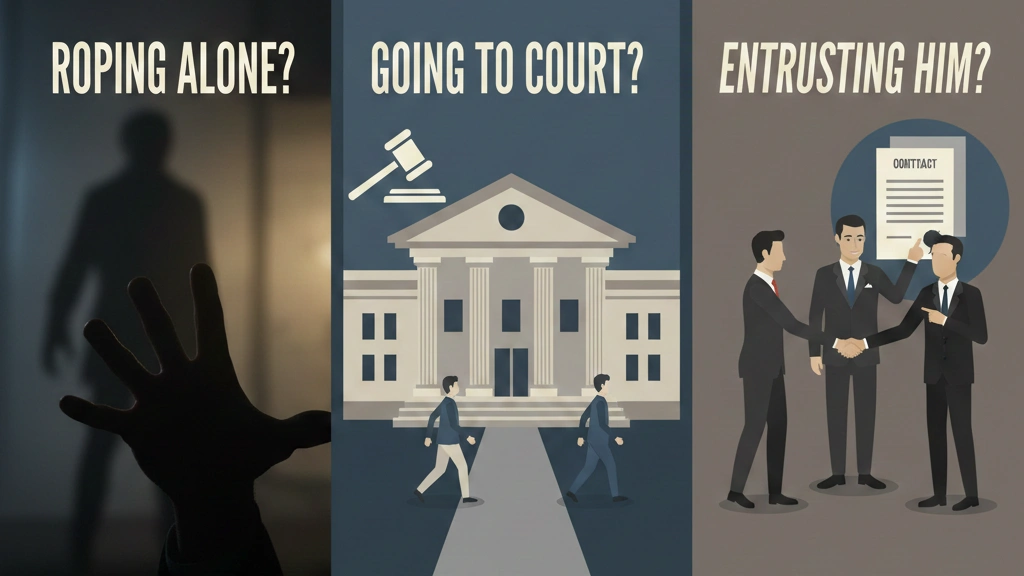
Is it groping alone, going to court, or entrusting him? A sober decision-making guide
2026-01-30
When the truth becomes a multiple-choice question: build your three-dimensional decision-making coordinates
At some point in life, many people will face an unspeakable decision - when suspicion arises, should they investigate it themselves, hand it over to the court for a ruling, or entrust a team of professional detectives? This choice may seem simple, but it carries varying degrees of risk, time-consuming and emotional costs. In order to make decision-making more rational, you can put the problem into a "three-dimensional coordinate system" to think:The degree of information asymmetry、Time urgency、Professionalism of the evidence。
In situations of extreme information asymmetry—such as suspicion that a partner is hiding their whereabouts, or that there is a hidden risk on the part of a partner—an individual's judgment is often influenced by emotions and fragments of information. And when time is tight (such as on the eve of separation or signing a contract), delay means increased losses. The last dimension is the professionalism of the evidence: only evidence that meets the requirements of the Civil Procedure Law can be truly tenable. Many people ignore this point - "discovery" is not the same as "provable", and "legal evidence collection" is the key to protecting the truth and protecting oneself.
In other words, when these three dimensions are intertwined, your answer will become clear: the more complex the problem, the tighter the time, and the higher the requirements for the legitimacy of the evidence, the more professional intervention is required. On the other hand, if you just want to understand a detail of life, rational communication or self-validation may be sufficient. True maturity is not about rushing to act, but about knowing when to take a step forward on your own and when to turn to a more professional guardian.
Calm comparison of three paths: forensic choices in different situations
1. Self-Investigation: A Starting Point for Cautious Temptation
For situations where the questions are minor and do not involve significant legal consequences, self-investigation is a common option. For example, if you suspect that there is a contradiction in your partner's words or that there is ambiguity in your partner's background, you can preliminarily judge the situation through public channels, social media verification, or private observation of behavioral trajectories. This method is low-cost and flexible, but it also has hidden dangers.
First of all, it is easy to lack systematic investigation skillsAct rashly and alert the enemy, so that the other party can hide their whereabouts after being alert; Secondly, due to emotion-driven, self-investigators often fall into "confirmation bias" and only collect information that can confirm their guesses. More importantly, many private recordings, follow-ups or information interceptions are likely to touch the red line of privacy infringement or evidence collection without legal procedures. Even if "clues" are found, these data are still invalid evidence in the legal sense and have no litigation effect. This is why marriage investigations emphasize "legal compliance and evidence collection" rather than "acting on emotions".
2. Legal channels: When the case requires the intervention of public authorities
When the nature of the incident is serious, or involves property, tort, or even criminal issues, legal means are the most formal way to deal with it. The court, public security organs or lawyer team can provide credibility in the procedure and ensure the legality of evidence collection. For example, in divorce cases, the Marriage Law clearly requires that "whoever claims the claim must provide evidence", and even if the other party is indeed at fault, it must be proven through compliance evidence. Although the process of reporting, filing and prosecuting is complex, its advantage is that once the facts are confirmed by the judicial organs, they have enforceability.
However, this path is not suitable for everyone. In reality, many people often reach an impasse due to "insufficient evidence" when a case enters the litigation stage. The high threshold for filing a case, the long cycle, and the strict requirements of the evidence chain all require full preparation in the early stage. As a result, there is a "preparation interval" between legal procedures and private investigations: that is, before the formal filing of the case, the factual basis is improved through legal investigation services. It is in this link that the value of private detectives is highlighted.
3. Commissioning a Private Investigator: Let the suspicion turn into an assessable fact
In the context of marriage investigations, business investigations, or tracing assistance, when information asymmetries are severe, issues cross regions, or involve high standards of confidentiality, entrusting a legally registered private detective firm is an efficient and rational choice. Professional detectives are familiar with evidence collection regulations, understand the Personal Information Protection Law, Public Security Administration Punishment Law and other boundary norms, and ensure that all investigations are carried out within the legal scope. Their task is not to spy, but to useProfessional, hidden and efficientThe "doubt" that relies on speculation is transformed into a "chain of facts" that can be rationally evaluated by the law and the parties.
Compared with self-investigation, the professional team hasLegal evidence collection qualifications and technical capabilities, can build a complete evidence chain through monitoring area analysis, public file retrieval, legal interviews and risk portraits. At the same time, its confidentiality agreement mechanism can provide the client with a sense of psychological security outside the procedure - not only protecting information, but also the dignity and privacy of customers. For those preparing to initiate litigation or assess the fate of a marriage, this pre-verification service is often a prelude to "risk control".
| options | Applicable cases | Advantages: | Disadvantages |
|---|---|---|---|
| Investigate yourself | Mild suspicion and easy access to information | Flexible, low-cost, and instant start-up | Easy to make mistakes, difficult to keep secret, and high risk of invalid evidence |
| Legal avenues | The facts are clearer and power needs to intervene | The procedure is formal and credible | The cycle is long, the case is difficult to file, and the requirements for presenting evidence are strict |
| Commissioning a private investigator | High-risk decision-making and information asymmetry are serious | Professional evidence collection, legal confidentiality, and improved litigation readiness | It is necessary to identify the qualifications and compliance of the institution |
In which situations is worth entrusting? Which ones should be restrained?
Suitable for commissioning detectives
- Suspicion of spouse infidelity requires the collection of factual support that can be used as legal evidence.
- Before major cooperation or investment, conduct a compliant background check to prevent economic risks.
- Find missing or key witnesses to provide clues for legal proceedings or family reunification.
- In the context of hidden infringement (such as candid photography, workplace harassment), evidence needs to be fixed through legal means.
The commonality of these situations is that they involve major personal rights and interests, time is tight, and the information needs to have legal effect. Commissioning a detective is not a "redundant move" but an investment in the integrity of evidence. Through professional investigation, clients can build a legal action path with lawyers with a more solid factual basis, so as to rationally protect themselves outside of emotions.
It is not recommended or requires careful entrustment
- Trying to learn about someone's private life out of curiosity or prying eyes.
- Detectives are required to obtain information through illegal means (such as eavesdropping, secretly filming, hacking accounts).
- Without specific factual basis, the investigation was commissioned out of emotional revenge.
In these cases, regardless of the outcome, it can hit legal red lines or break trust. Rational detective agencies will reject such commissions and use legal compliance as a red line. This is not only professional ethics, but also the protection of the long-term interests of customers. When the act of forensic collection crosses the moral and legal boundaries, the truth loses its original meaning.
Rational decision-making: The meaning of truth is protection
The starting point of every investigation often comes from uneasiness; And every rational decision will make people regain a sense of control. The value of the existence of a private investigator is never in "peeping", but in "clarifying" - helping the client make decisions with facts, rather than exhausting himself in suspicion. Marriage investigation and evidence collection, background checks, or evidence fixation are all risk management in nature. When a person can face the truth in a legal and professional way, he is already protecting his dignity and boundaries.
Before choosing, ask yourself: Do I need the truth or emotions? Is it a real answer, or a revenge? When the answer is, "I want to know the truth rationally and act under legal protection," that's when it's time to let the pros help. And true courage is not to act impulsively, but to be willing to use the light of reason to find a fact that can be faced safely.
Frequently Asked Questions (FAQs)
Is it legal for private investigators to collect evidence?
As long as the investigation does not involve infringement of personal privacy, freedom of communication, or the use of illegal equipment to collect evidence, and the detective agency has registration qualifications and compliance systems, evidence collection is legal. The key is whether the detective's behavior and information source comply with legal requirements.
Can marriage investigation forensics be used in court?
Only materials that meet the authenticity, relevance and legality of the evidence can be accepted by the court. For example, legally obtained travel records, public place images, witness testimony, etc. Unauthorized eavesdropping, candid photography, etc. are invalid evidence and may even bear legal liability.
What to look for when choosing a detective agency?
The institution's industrial and commercial registration information, confidentiality agreement terms, past service cases and legal evidence collection procedures should be verified. Formal institutions will clearly state the evidence collection methods that can be provided and the high-risk requirements for non-acceptance, and take "compliance" as the bottom line.