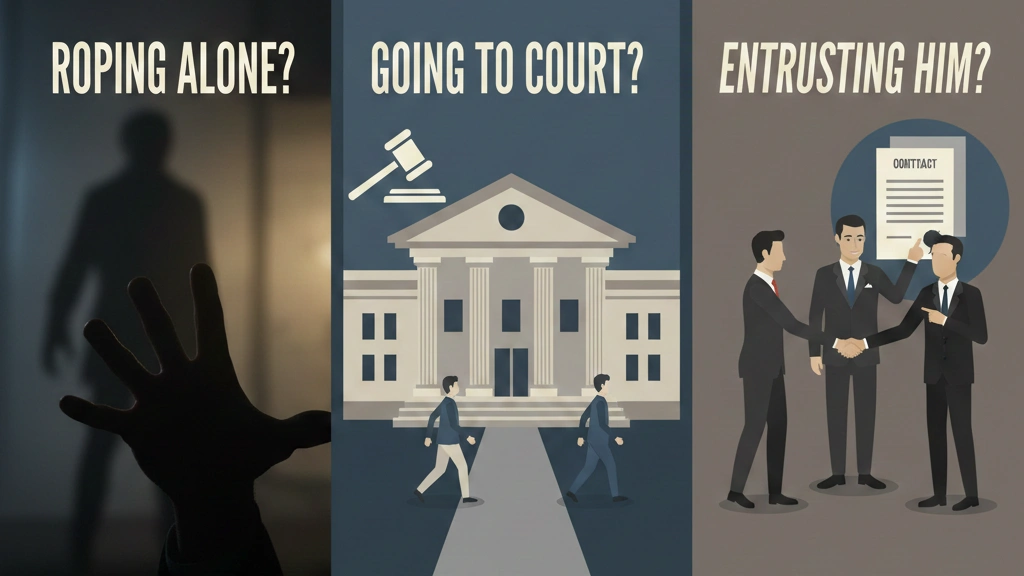

Accept the trust of others, and be loyal to others. Efficient, confidential and secure. It's a matter of loyalty. Efficient, confidential and secure.
Absolute Silence: How We Build a System of Confidentiality Tighter Than You Think|The Cornerstone of Trust in Marriage Investigation and Forensics
2026-03-06

Putting yourself in your shoes: real fear, not expense
When people consider commissioning a marriage survey, on the surface, they are concerned about price, cycle and results, but what really makes them hesitate is "if things are leaked, will it cause more harm". At GAOGE, we've seen too many clients torment themselves in the midst of hesitation—wanting to settle their doubts with the truth while fearing that the "truth" will be known by others. Confidentiality is not just a procedural requirement, but a bottom line synonymous with trust.
We always believe that the meaning of marriage investigation is never to expose or debunk, but to help clients collect evidence reasonably, protect their rights and interests, and avoid being harmed again by rumors or false information. Therefore, building a "secret room" confidentiality system is the highest priority commitment of GAOGE. Every piece of information, every communication, every small operation is carried out under the supervision of a strict mechanism to ensure that "only you can decide when the truth will be seen".
Multi-level confidentiality architecture: a fully closed line of defense from physical to psychological
Physical and information isolation: Let the data not circulate and the risk is zero
At GAOGE, all delegated materials are stored in individually locked filing cabinets, during which paperless and digital systems work together to avoid "copying" as a leak channel. The computer equipment uses encrypted hard disks and completely disconnects from the Internet to ensure that no task information can be intercepted over the network. Each investigation task is "fragmented" in the system – any single investigator has only the information necessary for the execution and does not have access to the full project details. This "necessary to know principle" makes it impossible to piece together the whole picture of the customer even if a single point is lost.
This system not only complies with industry standards for privacy protection, but also meets the legal requirements of the Civil Code for information confidentiality obligations in entrustment relationships. We understand that confidentiality is not only about preventing data leakage, but also about limiting "curiosity" - the combination of information classification and physical isolation eliminates the risk of human overcontact.
Process confidentiality: Leak-proof from code communication to encrypted communication
In the implementation of the investigation project, we adhere to the "principle of anonymization": all customers and investigators only use code names or pseudonyms, and avoid the appearance of real names, phone numbers, addresses and other key information in emails, chat records, and work documents. The communication process adopts end-to-end encrypted channels (such as dedicated communication apps and one-time key systems), and each piece of information only exists during the task period, and the "instant destruction" mechanism is triggered after the task is completed.
At the same time, all images, audio, or documents are marked with a tracking number to ensure that the source of any document can be identified immediately in the system in the event of abnormal use. For non-essential intermediate materials, we implement the principle of "production and sale" - the system immediately removes the remaining copies after completing the phased analysis, and only retains the version that meets the requirements of the legal evidence chain to balance the boundary between "legal forensics" and "safe destruction".
Personnel constraints: People are the most vulnerable and strongest part of the system
GAOGE Every investigator, project assistant, and account manager undergoes rigorous background checks and ethics assessments. Entering the company means signing a legally binding confidentiality agreement, which covers the behavior of the employee and the five years after leaving the company. Conduct privacy compliance training once a month, extract actual cases from the Personal Information Protection Law, Cybersecurity Law and other laws and regulations for analysis to ensure that each member understands the boundaries of "legal evidence collection".
We also have a human monitoring system: any data access, copy, and export operations are encrypted logs, and unauthorized operations will automatically trigger security alerts. Through this internal self-restraint mechanism, GAOGE forms a closed-loop system at the level of preventing "internal leaks". This is not only a reflection of professional ethics, but also an extension of customer trust.
Crisis plan: When sudden risks arise, protection takes precedence over explanation
Any secrecy system must take into account "extreme cases". GAOGE has established a multi-level crisis plan, and when the investigation is exposed to external intervention or accidental exposure, it immediately activates the "circuit breaker mechanism" - including suspending external transmission channels, locking all access ports, and using preset neutral interpretation schemes externally. We will reasonably conceal the true purpose of the task in external communication without triggering the customer's identity association to protect the client from external speculation and collateral risks.
This mechanism concept comes from the "necessary defense principle" in the law - in times of crisis, protect people first, then protect things. For us, interpretation is always behind, and protection is always first. All actions are based on the safety of the client, which is also the true embodiment of "absolute silence" as a moral restraint and professional belief.
Extreme thinking: How do we respond when confidentiality encounters legal boundaries?
Some customers are worried: "If the detective agency is investigated by the law under special circumstances, will the information be forced to be made public?" This is a very realistic question. The law does stipulate that in criminal investigations or judicial proceedings, when the content of the investigation touches the public interest or the scope of the law, the agency must cooperate in accordance with the law. However, GAOGE has "decentralized" and "technically segregated" information in the system design. This means that even if an external call occurs, only the forensic part of the task number and legal compliance can be provided, and the relationship between the customer's identity and the purpose of the investigation cannot be stitched together.
To the extent permitted by law, we always insist on the obligation to protect the privacy of our clients to the greatest extent. In accordance with the relevant provisions of Articles 1032 to 1039 of the Civil Code, personal privacy and information shall not be illegally read, stored, disseminated or used; Any cooperative behavior must be carried out under the supervision of a lawyer and formal documents. Our internal "technical isolation layer" further ensures that even if internal systems are accessed, real customer data exists independently in the physical isolation port.
In simple terms, even under the most severe external pressures, "customer identity" and "task information" will never appear on the same page. This is the core logic of GAOGE's secrecy philosophy: within the legal framework, say no more, leave no more lines.
The shape of trust: Behind absolute silence is a sense of security to be understood
Confidentiality is not only a system, but also an attitude. We have always believed that true trust is not "believing you won't say", but "knowing that you won't say even if asked". In such a sensitive field as marriage investigation and evidence collection, the client needs not an institution to carry out the task, but a partner who can take risks and remain silent for him. GAOGE confidentiality system, from equipment to people, from processes to legal defenses, constitutes a true "secret room-level trust space".
In this space, the truth is protected and not exposed; Evidence is kept and not disseminated. Every silence of the client is respected, and every bravery is guarded. Because we believe that the best protection is never to persuade people to give up, but to make people choose to face it with peace of mind.
FAQs
Q1: Is GAOGE's marriage investigation evidence legal?
All investigation items strictly abide by the provisions of China's Civil Code, Marriage Law and Personal Information Protection Law, collect evidence and analyze only within the legal scope, and prohibit secretly filming, stalking or violating the privacy of others.
Q2: How do you ensure that customer information is not known to third parties?
The system implements data classification and physical isolation, and all personal data is encrypted and stored, which can only be accessed under the supervision of lawyers after the task is completed, and is automatically destroyed after the confidentiality period expires.
Q3: Will customer information be disclosed if asked by the police or the media?
GAOGE will not disclose customer information to any organization or individual unless a formal legal instrument is received. If requested to cooperate, we will strictly control the scope of information accompanied by a lawyer to ensure the safety of our clients.
The weight of the truth: How useful can the evidence obtained by private investigators play in court?
Clarify a common misconception: detectives do not produce judicial evidence
In the field of marriage investigation and civil forensics, many people mistakenly believe that as long as they invite a private detective firm, they can obtain "court-recognized" conclusive evidence. However, the logic of the law is not like that. The role of private investigators in the legal system is to assist parties in discovering and providing the truthEvidence materialorClues, rather than directly "producing" judicial evidence.
In the true senseJudicial evidence, must meet three core criteria: authenticity, legitimacy, and relevance. This means that it is not only necessary to ensure that the facts reflected in the evidence are true, but also to ensure that the collection methods comply with the law and do not infringe on the privacy or public order of others. What private investigators can provide to their clients is the factual basis and information sources collected within the legal scope, providing direction for lawyers and courts to investigate and collect evidence.
In other words, if the courtroom is compared to a trial about the truth, then the detective's job is more like a lamp that illuminates the path. What they collect is not the end, but the tools to the truth. Only after the professional intervention of lawyers and the court's review and approval can these materials be transformed into truly legally effective evidence.
The legal transformation path of evidence materials
Direct Submission as Evidence: Establish legitimacy and authenticity
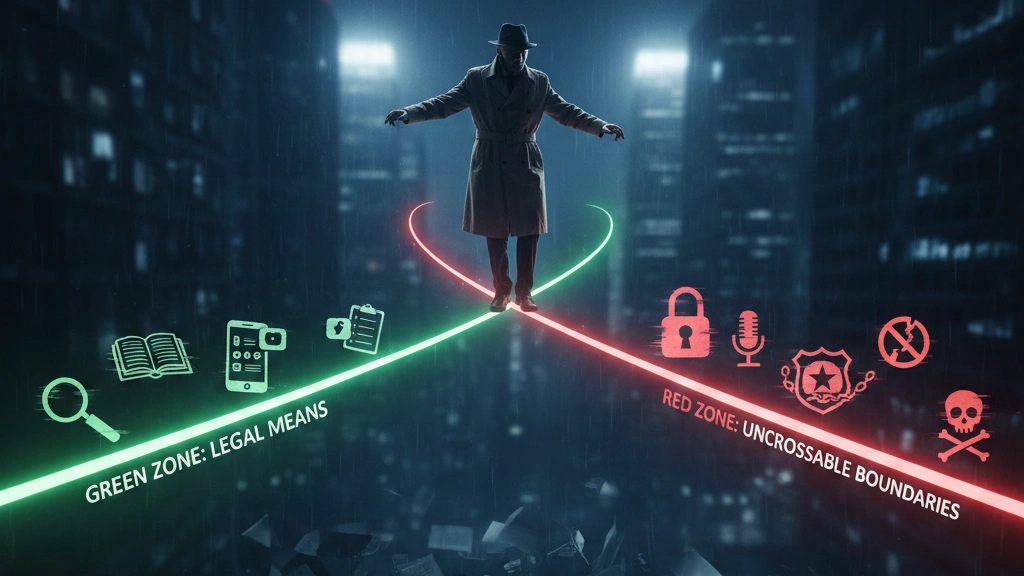
When the photos, videos, chat records or surveillance footage provided by the detective were obtained in a public space, did not violate the right to privacy, and were reviewed by the court, they have the opportunity to be directly accepted as official evidence. Such materials are commonly found in cases such as extramarital affair evidence, residence certificates, and property records. The key to their acceptance by judges lies in three points: the filming location is public, there is no illegal surveillance, and the time and subject matter are related.
For example, a video of a meeting shot in the restaurant lobby can be recognized as an objective record of facts; However, if a detective uses a hidden camera to enter a private residence or hotel room, it is illegal evidence collection and may put the client at civil or criminal risk. Professional detective agencies such as GAOGE have always insisted on "collecting facts within legal boundaries", not to create temporary "shocking evidence", but to lay a solid foundation for future judicial proceedings.
As a clue, the issuance of the court investigation order was promoted
In many cases, detectives find not directly submittable evidence, but influence the direction of the caseForensic clues。For example, bank account association, property transfer channel, real estate registration record, or corporate equity information. According to Article 64 of the Civil Procedure Law, the parties have the right to apply to the court for investigation and evidence collection, and this application must have specific clues and reasons. In other words, the factual basis found by the private investigator provides direct support for lawyers to apply for an "investigation order".
After obtaining the investigation order, lawyers can formally obtain information from banks, real estate registration centers or tax authorities through legal channels of the court, completing the "closed loop" from private investigation to judicial evidence collection. In practice, this "clue-to-evidence" path often determines the success or failure of a case. Professional detective reports allow lawyers to have a stronger logical chain in court, and also reflect the client's respect and rationality for the rules.
As a source of confidence for negotiation and mediation
In fact, the power of detective evidence is not only reflected in the courtroom. Many family disputes, marital crises, and cooperative disputes have reached a conclusion through negotiation or mediation before they even go to court. At this time, a true, detailed and chronological integrity survey material can often become an important psychological game bargaining chip. It is not used to threaten, but to make the other party realize that "the truth is grasped", thereby leading to a more rational and equal dialogue.
In this case, the "validity" of evidence is no longer in the legal sense, but in the real game. It allows the parties to avoid blind persistence, reduce emotional decision-making, and also leave room for family relationship repair. Therefore, when facing customers, GAOGE has always emphasized that the purpose of investigation is not to tear apart, but to help the truth land, and lay a rational foundation for protecting its own rights and interests and promoting fair negotiation.
Different types of evidence have different legal effects
Audio-visual materials: high authenticity, but the boundaries of forensic collection need to be cautious
Audiovisual materials (videos, audio recordings, surveillance captures, etc.) are often considered the most convincing evidence because they visually present the moment when the facts occurred. However, from a legal point of view, the validity of such evidence depends on three conditions: the legality of the filming location, the content has not been tampered with, and the method has not violated privacy. For example, video materials taken in open spaces such as public roads, hotel lobbies, and office elevators can generally be used as evidence; On the contrary, recording and recording in a private space without permission violates the privacy protection provisions of the Personal Information Protection Law and the Civil Code.
Written reports and whereabouts records: Evidence chain corroboration is required
Detective reports are usually presented in writing, including the subject's whereabouts timeline, behavior records, contact objects, etc. This information, while not directly constituting judicial evidence, can be considered as an extension of witness statements or statements made by parties. When the court determines its validity, it will combine other evidence to corroborate it, such as mobile phone positioning records, consumption flow, traffic tracks, etc. In other words, the value of the report is not "established alone", but in "building a chain of evidence".
Detectives with legal logic training will follow the "three-element standard" when writing reports: clear time nodes, clear behavior chains, and orderly evidence citation. This structure not only facilitates lawyers to cite, but also allows judges to accurately understand the relevance of materials. GAOGE has always insisted in practice: the report is not a conclusion, but a rational narrative, and its role is to reduce ambiguity and increase trust.
Photographs and image materials: as an important supplement to physical evidence
As intuitive visual evidence, the legal effect of photographs is between physical evidence and auxiliary materials. If the time, place, and object of the shooting can be clarified, and the photographer issues a statement of authenticity, supported by other evidence, there is a certain possibility of acceptance. Conversely, if the source is unknown or there are traces of editing, the court may rule out admissibility altogether. Therefore, when providing picture materials, detective agencies will recommend that customers save metadata such as original files and EXIF information at the same time to verify authenticity if necessary.
From the perspective of legal experience, the most valuable role of photos is often not to be the "basis for conviction", but to help lawyers construct the logic of the case. For example, time-series photos can prove facts such as long-term contact relationships and property use habits to provide direction for subsequent investigations. This reflects the true meaning of "evidence materials" - not the result, but the "starting point of the path".
Professional Warning: Be wary of false promises of "guaranteed availability"
There is no shortage of irresponsible practitioners in the market to attract clients under the banner of "ensuring that evidence can be used in court". Such commitments often imply legal risks. According to judicial practice, whether it is a photo, audio recording or investigation report, it can only be accepted after being reviewed and confirmed by the court to be legally obtained. Any promise of "winning" and "acceptance" is inherently misleading or even illegal.
GAOGE always adheres to the bottom line of professionalism - we don't create evidence, we only help our clients discover the truth. The significance of the investigation is not to confront it, but to protect its own rights and interests and assist the law to a fairer conclusion. A truly trustworthy private detective agency should have a clear evidence collection compliance process, a self-discipline review mechanism, and a team of lawyers and consultants to ensure that every material can stand in the sunshine of the law.
Legal evidence collection is the cornerstone of trust for private detectives; Rational protection is the deepest protection for customers. We believe that the power of truth lies not in presenting conflicts, but in allowing every party to be understood, protected, and respected in the order of the law.
Frequently Asked Questions (FAQs)
Can recordings obtained by private investigators be used in divorce cases?
Recordings may be admissible only in public or if the parties themselves have recorded them. If it involves the privacy of a third party or unauthorized recording in private space, it will inevitably be recognized as illegal evidence collection.
If the detective takes photos of extramarital affairs, will the court accept them?
Not necessarily. Before accepting the photo, the court will comprehensively judge the authenticity, completeness and legality of the photo. If the film is taken in a public place and has not been technically tampered with, it may have evidentiary effect.
Can I use a detective report to assist a lawyer in applying for an investigation order?
Yes. The property clues, transaction paths and other information in the report can become the basic materials for lawyers to apply for the "Investigation Order", so as to realize the transformation from materials to formal judicial evidence.