

Accept the trust of others, and be loyal to others. Efficient, confidential and secure. It's a matter of loyalty. Efficient, confidential and secure.
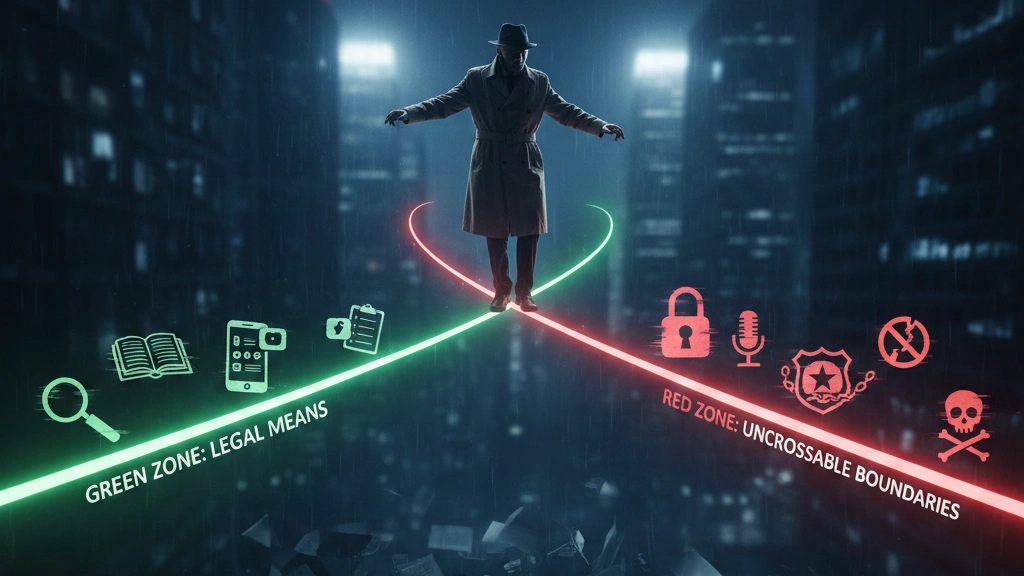
Walking on a tightrope: uncovering the legal means of private investigators and the insurmountable red line
2026-01-23
The method is wrong, and the whole game is lost: a real case of being prosecuted for illegal evidence collection
A few years ago, a woman in Shenzhen entrusted an informal detective company to investigate her spouse's behavior before the divorce lawsuit, and the other party installed a car locator and a bedroom camera without authorization in order to "quickly get the evidence". In the end, these so-called "ironclad evidence" videos were not only judged illegal evidence in court, but also led to the client's suspected invasion of privacy and was countersued by the other party. The twist of the case made her heartbroken - the truth, which was supposed to be a tool to protect herself, eventually became a sharp blade that bite back at her.
This case reveals an often overlooked fact: investigations are not for everyone, let alone a "results-oriented" gray area. Walking on the boundaries of law and ethics, every step determines the final direction. If the method is wrong, you will lose the whole game.
The three core means of legal investigation
In-depth mining of public information: Find the truth from legitimate data
In the work system of professional detectives, "the legality of the source of information" is the first threshold. The so-called "public information" refers to the acquisition of public records, enterprise registration data, social media updates, and judicial document announcements through legally permitted channels. These are all within the category of information that can be used in accordance with the law. When conducting marriage investigations, private detectives often use tools such as corporate credit systems, court judgment announcements, and content comparison on social platforms to sort out behavioral trajectories and interest relationships. Through keyword semantic retrieval, timeline comparison, and social relationship graph analysis, the context of events can be restored and a preliminary evidence chain can be established without touching the privacy red line. The value of this approach is that it is not only compliant but also repeatedly validated. An evidence obtained from public channels can gain higher credibility in court and reflect the professionalism and stability of the investigator.
Legal peripheral investigation: Observe in public spaces, not infringe
"Observation" is a common technique in marriage investigations, but its boundaries must be clear. Legitimate external investigations should be limited to public places, such as streets, hotel lobbies, restaurants, parking lots, etc. These locations are relatively open venues, and individuals cannot claim full privacy. Professional detectives are usually equipped with forensic record sheets, time coordinate systems, and adhere to the three principles of "no entry, no interference, and no tracking". If it involves follow-up and evidence collection, it is necessary to ensure that the footage only focuses on specific events and does not contain unauthorized portraits of third parties. At the same time, the image data needs to be encrypted and managed by number, so that it can be submitted to a lawyer for legality review if necessary in the future. This kind of "legal peripheral investigation" tests not only technical ability, but also conscious awe of the bottom line of the law. Only by limiting the investigation to the boundaries of rationality can the results truly have protective significance.
Logical analysis and cross-verification: the integrity of the evidence chain comes from rationality, not "candid photography"
Many people mistakenly think that the key to the investigation is to "catch the bag on the spot", but in fact, what can really impress judges and lawyers is a coherent and verifiable logical chain. After collecting information, the investigator verifies the authenticity of the information through cross-verification methods. For example, does a consumption record match social dynamics and itinerary trajectory? Can a hotel bill be verified by the public electronic invoice system? Together, these links constitute a "closed loop of evidence". Accurate logical reasoning and timeline analysis are the core competitiveness of legal investigations. In actual execution, the GAOGE detective team built a "data triangular verification model" so that each piece of information can find an independent support point. When the investigation is based on rational logic, the truth has the weight of law.
An insurmountable red line: the double bottom line of law and ethics
Legal red lines: Private investigators are not law enforcers
China's Criminal Law, Public Security Administration Punishment Law, and Civil Code all clearly stipulate personal privacy, information security, and housing security. Any form of invasion of residences, installation of eavesdropping and photo equipment, interception of communication information, hacking of accounts, etc. is suspected of violating the law. Legal marriage investigations should be based on "legal channels" and "reasonable methods". Detective companies must not impersonate public security, procuratorates, lawyers and other public officials, bypass system protection through technical means, and must not use purchased "gray data". Once these behaviors are verified, not only the evidence will be invalidated, but may also violate criminal law, causing a two-way risk between the investigator and the customer. In the Code of Practice of GAOGE, all cases are required to go through a pre-trial system to ensure that the evidence collection method is consistent with the requirements of Article 63 of the Civil Procedure Law regarding the legality of evidence. Legal evidence collection is the most responsible professional ethics for customers.
Ethical red line: Truth should not come at the cost of harm
Beyond the boundaries of law, there is also a bottom line of ethics. The value of the detective profession is not in "exposing", but in "guarding". Any act that induces crime, stalking, intimidation, or disclosing personal privacy is a betrayal of the spirit of investigation. GAOGE summed up the "three no's" in the long-term process of taking on the case: do not cross the line to collect evidence, do not maliciously expose, and do not harm the innocent. Regardless of the conduct of the subject of the investigation, he should not be the subject of moral trial, and the information of family members and third parties unrelated to the case shall be protected. A truly responsible private investigator is not to "vent his emotions", but to help clients restore rational judgment and provide a solid foundation for subsequent legal actions.
The author's note: Regarding the boundary of legal evidence
From a legal point of view, Article 1032 of the Civil Code of the People's Republic of China clearly stipulates that natural persons enjoy the right to privacy, and no organization or individual may infringe on the privacy of others by spying, secretly filming, eavesdropping, disseminating, etc. The Criminal Procedure Law and the Civil Procedure Law also establish the principle of legality for the method of obtaining evidence, and evidence obtained by illegal means should be excluded. On this line, the key to legal evidence lies in the "three natures": the legality of obtaining, the authenticity of the content, and the relevance of the form. In other words, even if the content is true, if the method of obtaining it is illegal, it cannot be the basis for judicial judgment. This is why GAOGE always emphasizes the two major safeguard mechanisms of "legal evidence collection" and "compliance process". Truth and justice are never forcibly plundered, but the result of a balance between rationality and the system.
Conclusion: Let the edge of the investigation maintain temperature and justice
In the gap between marriage and trust, every decision is like walking on a tightrope. Choosing a detective agency that abides by the law, respects privacy, and has professional ethics means choosing a safer and more dignified path. Legal investigations are not restrictions, but protections. It protects customers from risks and also protects the truth from questioning. For GAOGE, every survey is not only about finding answers, but also about protecting the bottom line of marriage rationality and the boundaries of social trust. This restraint and awe are the foundation of the industry.
Frequently Asked Questions (FAQs)
What evidence in a marriage investigation can be admitted by the court?
The evidence recognized by the court includes: data records from public channels (such as consumption, travel, communication bills), legally taken images of public places, and communication records between the two parties (subject to their authorization or legal evidence collection). However, evidence obtained from secret photography, eavesdropping, and trespassing on residences will be directly excluded.
What documents do you need to sign to hire a private investigator?
Regular companies will sign documents such as the Entrustment Agreement, Confidentiality Agreement, and Legal Evidence Collection Statement to clarify the scope, purpose, implementation standards and privacy responsibilities of the investigation. GAOGEAll cases are identity verified and intent screened to ensure that every investigation meets ethical and legal standards.
How to determine whether a detective's conduct is infringing?
If it involves entering private space, obtaining communication content, or disseminating private information, it is an infringement. The client should take the initiative to request the investigative agency to explain the evidence collection methods and keep communication records. Legitimate detectives always keep the boundaries clear to the client.